Turn AI From a Thought Partner Into Your Teammate
And no, we’re not talking surreptitious lay-offs…
8 May 2026
By Jack Alderson, Founder
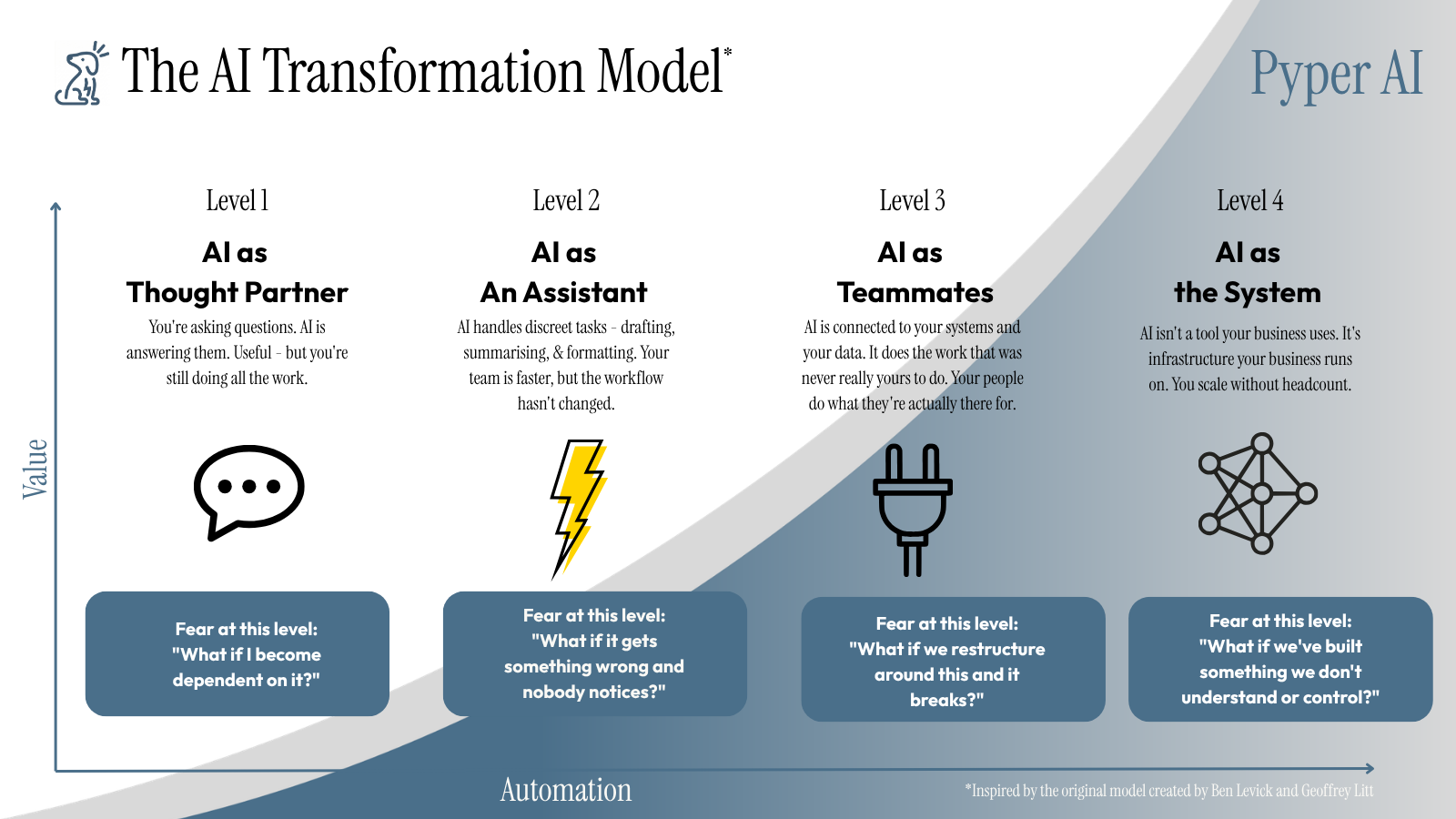
Are you familiar with this AI transformation model? Created by Ben Levick, Head of AI & Ops at Ramp, and Geoffrey Litt, Author, MIT researcher and Engineer at Notion, it’s been widely shared alongside versions from OpenAI and McKinsey, plotting the ascent and maturity of this technology across four levels: AI as a Thought Partner, AI as an Assistant, AI as Teammates, and finally AI as the System itself.
As a boutique AI builder specialising in AI integration for SMEs, we see that the challenge around implementation isn’t necessarily a tech issue - it’s a business one. Or maybe even more specifically, it’s a human one.
And before you click away: we are definitely not anti-human at Pyper AI. Quite the reverse. We believe being human becomes more important as the technology develops, not less. The business owners, entrepreneurs and intrapreneurs we work with aren’t being replaced - and neither are their teams. They’re being freed up to do the human work that actually needs them.
So let’s dig into the model and see where the gaps are, and how you can begin to bridge them.
Where most businesses are actually stuck
Many owner-directors we talk to are sitting somewhere between Level 1 and Level 2 on the curve. They’ve got ChatGPT or Claude open in a browser tab. They use it to sense-check ideas, draft emails, and summarise things. It’s useful, but it’s not transformative. (Although the memory of the first time you came across ChatGPT would disagree - it felt like magic.)
AI becomes a very good search engine, a shortcut, and a sounding board. It’s a thought partner they occasionally consult and just as often ignore. And there are clear benefits of that, but it’s not what people were promised, and it’s a long way from what’s possible.
The jump from Thought Partner to Teammate - Level 3 on the model - is where the real value sits. And it’s also where most businesses give up. Not because the technology isn’t capable of it, but because crossing that gap requires something the AI companies don’t package up and sell you: someone who understands how your business actually works and can traverse the data and processes, and show the possibilities that are now possible. And not at the six figures and yet another quarter rate that SMEs have traditionally had to integrate technology.
The tool-shaped problem
Most AI sits outside your business rather than inside it: you go to it, ask something, get an answer, and then manually carry that answer back into whatever system or document or conversation your business lives in. The thinking is borrowed from AI, and the doing is still entirely yours.
What changes the equation is integration - connecting AI to the actual workflows, data, and systems where your business runs. It’s not so that it can replace the people doing the work, but so that it can handle the repetitive, standardised parts of the work and free the team up. There’s a useful distinction here between tasks that require human judgement and tasks that merely consume human time. The former is where your team earns its keep, and the latter is where AI should be doing its job.
What “integration” actually means in practice
One of the challenges of a new technology is understanding the taxonomy of its language. What does integration actually mean? It sounds expensive and messy and something that we might not think we have the patience or time for. But it doesn’t mean that. Think of it less as replacing your systems and more as giving them a brain - one that knows what’s in your CRM, can join the dots across your data, and starts surfacing the kinds of opportunities that get buried in the day-to-day. What that looks like is different for every business, and it should be.
Let’s take a mortgage broker, just as an example. Under FCA Consumer Duty, the documentation burden has grown significantly - suitability reports, vulnerability assessments, and audit trails that prove the advice given was genuinely in the client’s interest. Most brokers are doing that work manually, case by case, because as regulation has increased, there was only one option: get a person to do it. This acceleration of regulation means it’s not a stretch to say that the most experienced, qualified people are spending a meaningful chunk of their week on compliance writing rather than client relationships.
An integrated tool can take the case data that already exists in the broker’s system and produce a compliant first draft - structured correctly to the FCA requirements and the broker’s business needs and brand, evidenced properly, and ready for review. The broker still reads it, still owns the advice, and still applies their judgment. The human is the decision maker - but a significant portion of the administrative load disappears.
That’s what AI as a teammate does. It shows up on time, every time, to the parts of the work where the perfunctory rules determine output, so we humans can be fully present for the parts that need us.
The 20% that nobody talks about
The thing the AI companies don’t advertise, because it doesn’t make for good product marketing, is that the capable part of AI is mostly free. The capable-in-your-specific-business part is where the work is and where the blocker can be.
Getting AI to draft a good proposal is easy. We’re all getting much better at asking it for what we want. But getting it to draft your proposal - with your pricing logic, your client data, your brand guidelines, and output directly into the format your team actually uses is where most businesses hit a wall. The transfer of that necessary context is time consuming and different depending on who delivers it.
And that gap is roughly 20% of the total problem. It involves workflow mapping and design, security, integrations, and making sure nothing breaks when it’s in daily use by people who didn’t build it. It requires someone to have looked at your business properly and built something for it, rather than something that merely resembles it - or goes only so far.
Most small businesses try to paper over that 20% with manual workarounds. It’s understandable - the first 80% is genuinely impressive, and workarounds are faster than proper solutions. But the workarounds compound, the friction accumulates, and before you know it, what should have been a productivity gain becomes another layer of complexity.
What the shift actually requires
Moving AI from Thought Partner to Teammate isn’t a technology decision. It’s an operational one - and a human one.
Before you make any decisions, it’s about setting aside the fear that the tech is in charge. It isn’t, and it won’t be. It’s there to augment human capabilities, not become the overlord of your business. It’s a massive opportunity, when done well. Once you commit to rethinking productivity in practical terms, not wishful ones, you have to be honest about where your time actually goes - not in theory, but in a typical week. Think about the repetitive, the formatting, the summarising, the incessant chasing, the briefing-people-on-things-that-are-already-documented.
Then ask: which of those things genuinely need a person, and which just need doing? This can be hard to do - and that’s where there’s value in working with someone experienced in these kinds of implementations who can challenge the norm of entrenched processes that maybe it is time to let go of.
A note on fear. Every level of this model comes with its own version of it. “What if I become dependent on it?” at Level 1. “What if it gets something wrong?” at Level 2. “What if we restructure around this and it breaks?” at Level 3. The fears are real, they’re rational, and they’re almost never talked about honestly in AI conversations. In our next post, we’ll go through each one practically - how to assess the real risk, and build in the safeguards that let you move forward anyway.
When we go through this process with clients, the answer is usually more enlightening than they expect. It’s not because there’s a dramatic amount to automate - often it’s one or two workflows that, solved properly, change the shape of the whole working week - or because the team shrinks. Instead, processes become better optimised, the team is relieved of some of the more arduous admin and can focus on the real value-added work, and you see your business through new (A-) eyes.
That’s the shift. AI stops being something you use like a personal search engine and companion, and starts being something that works alongside you, for you, freeing up time and mental space. Invisible in operation, obvious in result. And your people - no longer busy with tasks that took up their time and energy - get to do what they’re actually there for. More productive people, thanks to AI. Who knew?
Well, we do. At Pyper AI, we’re not technologists who learned about business, or business people who got excited about AI. We’re both - and if you’re looking for a partner who understands your business as well as the technology, that’s exactly what we’re here for.
If you’re ready to move from AI as a thought partner and explore what AI integration looks like for your business, book a free 30-minute call and tell us what’s stuck.